YouTube - Dell Laptop Explodes on Chaser
27 सेकेन्ड - 4 अगस्त 2006 -
Another Dell laptop explodes but this time on Australian TV. Clearly this is a fake, but it goes nicely with all the Dells spontantiously combusting these d ...
www.youtube.com/watch?v=4XHaz5EM9jc
Upgrade Dell Computer Laptop Memory, IBM, Lenovo - identify RAM ...
Upgrade Dell, IBM computer & laptop memory. Identify & install DDR, DDR2 & DDR3 RAM.
www.memoryx.net/ - सँग्रहित प्रतिलिपिहरू - हुबहू
Laptop Repair, Dell Laptop Repair, Sony Laptop Repair, Sell Your ...
Laptop Service is Nationwide Center for laptop repair. We repair dell, Sony, HP, IBM, Toshiba, etc. Laptops. We provide free laptop repair Estimate.
www.laptopservice.com
dell laptop
Thursday, August 27, 2009

sports
free encyclopedia
Jump to: navigation, search
This article is about roadgoing cars. For racing cars, see Sports car racing.
Lotus Super 7, a fundamental sports carThe term sports car has been defined as "an open, low-built, fast motor car."[1][2] The term describes a class of automobile with two seats, two doors, precise handling, brisk acceleration, and sharp braking — trading practical considerations such as p
Wednesday, August 26, 2009
banking
Banking
500 x 333 - 23 किलोबाइटस् - jpg
sureitinc.com
BANKING/FINANCIAL COMPANIES
600 x 401 - 27 किलोबाइटस् - jpg
southlandrealestate.com
Banking Intelligence Cycle
320 x 320 - 29 किलोबाइटस् - jpg
sas.com
BANKING
337 x 506 - 55 किलोबाइटस् - jpg
govancreditunion.ca
personal banking.
294 x 408 - 86 किलोबाइटस् - jpg
smsisthenewblack.co.uk
mobile banking enthusiasts
450 x 303 - 64 किलोबाइटस्
mobile-weblog.com
The Bank and
470 x 364 - 8 किलोबाइटस् - gif
seasite.niu.edu
Banking Services · Online
300 x 300 - 15 किलोबाइटस् - jpg
ibankfmb.com
pay bills and bank online
393 x 283 - 120 किलोबाइटस् - jpg
witnessthis.wordpress.com
Outside In Banking
440 x 368 - 73 किलोबाइटस् - jpg
outsideinbanking.com
Euroclear Bank is a
338 x 321 - 46 किलोबाइटस्
euroclear.com
bank
297 x 313 - 25 किलोबाइटस् - jpg
blogs.myspace.com
bank metropolis Frankfurt
595 x 588 - 83 किलोबाइटस् - jpg
nordea.de
co op bank new hampshire
523 x 700 - 27 किलोबाइटस् - jpg
salemcoop.com
e-banking solutions in the
724 x 483 - 126 किलोबाइटस् - jpg
nordea.de
Getting a banking job in the
386 x 339 - 71 किलोबाइटस् - gif
successfulbankingjobs.com
500 x 333 - 23 किलोबाइटस् - jpg
sureitinc.com
BANKING/FINANCIAL COMPANIES
600 x 401 - 27 किलोबाइटस् - jpg
southlandrealestate.com
Banking Intelligence Cycle
320 x 320 - 29 किलोबाइटस् - jpg
sas.com
BANKING
337 x 506 - 55 किलोबाइटस् - jpg
govancreditunion.ca
personal banking.
294 x 408 - 86 किलोबाइटस् - jpg
smsisthenewblack.co.uk
mobile banking enthusiasts
450 x 303 - 64 किलोबाइटस्
mobile-weblog.com
The Bank and
470 x 364 - 8 किलोबाइटस् - gif
seasite.niu.edu
Banking Services · Online
300 x 300 - 15 किलोबाइटस् - jpg
ibankfmb.com
pay bills and bank online
393 x 283 - 120 किलोबाइटस् - jpg
witnessthis.wordpress.com
Outside In Banking
440 x 368 - 73 किलोबाइटस् - jpg
outsideinbanking.com
Euroclear Bank is a
338 x 321 - 46 किलोबाइटस्
euroclear.com
bank
297 x 313 - 25 किलोबाइटस् - jpg
blogs.myspace.com
bank metropolis Frankfurt
595 x 588 - 83 किलोबाइटस् - jpg
nordea.de
co op bank new hampshire
523 x 700 - 27 किलोबाइटस् - jpg
salemcoop.com
e-banking solutions in the
724 x 483 - 126 किलोबाइटस् - jpg
nordea.de
Getting a banking job in the
386 x 339 - 71 किलोबाइटस् - gif
successfulbankingjobs.com
business
Business School
400 x 300 - 8 किलोबाइटस् - jpg
campusaccess.com
Canadore College: Business
585 x 359 - 44 किलोबाइटस् - jpg
canadorec.on.ca
15.535 Business Analysis
400 x 300 - 40 किलोबाइटस् - jpg
ocw.mit.edu
businesses whose products
1280 x 960 - 230 किलोबाइटस्
cnsx.ca
There are various business
335 x 432 - 24 किलोबाइटस् - jpg
spoc-secretariat.org
in International Business
300 x 450 - 27 किलोबाइटस् - jpg
faculty.msb.edu
Everyone in business
482 x 410 - 34 किलोबाइटस् - jpg
dceb.ie
Hundreds of business cartoons
437 x 360 - 15 किलोबाइटस् - gif
glasbergen.com
Caption: Is business passing
500 x 362 - 47 किलोबाइटस् - jpg
hreoc.gov.au
Small Business Development
300 x 350 - 27 किलोबाइटस् - jpg
sbdc.unf.edu
Business Report. Print
700 x 479 - 71 किलोबाइटस् - jpg
oil.otago.ac.nz
Doing Business
617 x 758 - 46 किलोबाइटस् - jpg
psdblog.worldbank.org
business-oriented software
440 x 335 - 53 किलोबाइटस् - jpg
sharewareconnection.com
Business Lectures
300 x 300 - 23 किलोबाइटस् - jpg
otago.ac.nz
business.
400 x 317 - 52 किलोबाइटस् - jpg
spoc-secretariat.org
sCHOOL OF BUSINESS
464 x 312 - 141 किलोबाइटस् - jpg
widener.edu
400 x 300 - 8 किलोबाइटस् - jpg
campusaccess.com
Canadore College: Business
585 x 359 - 44 किलोबाइटस् - jpg
canadorec.on.ca
15.535 Business Analysis
400 x 300 - 40 किलोबाइटस् - jpg
ocw.mit.edu
businesses whose products
1280 x 960 - 230 किलोबाइटस्
cnsx.ca
There are various business
335 x 432 - 24 किलोबाइटस् - jpg
spoc-secretariat.org
in International Business
300 x 450 - 27 किलोबाइटस् - jpg
faculty.msb.edu
Everyone in business
482 x 410 - 34 किलोबाइटस् - jpg
dceb.ie
Hundreds of business cartoons
437 x 360 - 15 किलोबाइटस् - gif
glasbergen.com
Caption: Is business passing
500 x 362 - 47 किलोबाइटस् - jpg
hreoc.gov.au
Small Business Development
300 x 350 - 27 किलोबाइटस् - jpg
sbdc.unf.edu
Business Report. Print
700 x 479 - 71 किलोबाइटस् - jpg
oil.otago.ac.nz
Doing Business
617 x 758 - 46 किलोबाइटस् - jpg
psdblog.worldbank.org
business-oriented software
440 x 335 - 53 किलोबाइटस् - jpg
sharewareconnection.com
Business Lectures
300 x 300 - 23 किलोबाइटस् - jpg
otago.ac.nz
business.
400 x 317 - 52 किलोबाइटस् - jpg
spoc-secretariat.org
sCHOOL OF BUSINESS
464 x 312 - 141 किलोबाइटस् - jpg
widener.edu
nokia mobile
Mobile phone giant Nokia
300 x 351 - 40 किलोबाइटस् - jpg
slipperybrick.com
Nokia Mobile Phones
520 x 404 - 35 किलोबाइटस् - jpg
prlog.org
Nokia Mobile
312 x 312 - 10 किलोबाइटस् - jpg
europe.nokia.com
screen making mobile email
350 x 324 - 25 किलोबाइटस् - jpg
smartphonethoughts.com
Latest Nokia Cellphones With
478 x 407 - 63 किलोबाइटस् - jpg
tipandtrick.net
Nokia mobile
430 x 500 - 55 किलोबाइटस् - jpg
letsgomobile.org
mighty Nokia N96.
400 x 500 - 52 किलोबाइटस् - jpg
engadget.com
Nokia added another handset to
420 x 370 - 18 किलोबाइटस् - jpg
mobilewhack.com
the Nokia Mobile Broadcast
410 x 302 - 25 किलोबाइटस् - jpg
3g.co.uk
new Nokia mobile phones,
490 x 1136 - 84 किलोबाइटस् - jpg
blog.mobiles.co.uk
A Nokia mobile phone,
420 x 377 - 18 किलोबाइटस् - jpg
mobilewhack.com
PPImages/nokia-mobile.jpg)
640 x 479 - 31 किलोबाइटस् - jpg
popular-pics.com
Nokia 6300 Mobile Phone
393 x 481 - 31 किलोबाइटस्
cellularphonegallery.blogspot.com
About Nokia mobile phones
466 x 378 - 82 किलोबाइटस् - jpg
photokina-show.com
Nokia presents
400 x 392 - 64 किलोबाइटस् - jpg
itechnews.net
Nokia N91 Mobile Phone -
462 x 300 - 37 किलोबाइटस् - jpg
knowledgebase-script.com
300 x 351 - 40 किलोबाइटस् - jpg
slipperybrick.com
Nokia Mobile Phones
520 x 404 - 35 किलोबाइटस् - jpg
prlog.org
Nokia Mobile
312 x 312 - 10 किलोबाइटस् - jpg
europe.nokia.com
screen making mobile email
350 x 324 - 25 किलोबाइटस् - jpg
smartphonethoughts.com
Latest Nokia Cellphones With
478 x 407 - 63 किलोबाइटस् - jpg
tipandtrick.net
Nokia mobile
430 x 500 - 55 किलोबाइटस् - jpg
letsgomobile.org
mighty Nokia N96.
400 x 500 - 52 किलोबाइटस् - jpg
engadget.com
Nokia added another handset to
420 x 370 - 18 किलोबाइटस् - jpg
mobilewhack.com
the Nokia Mobile Broadcast
410 x 302 - 25 किलोबाइटस् - jpg
3g.co.uk
new Nokia mobile phones,
490 x 1136 - 84 किलोबाइटस् - jpg
blog.mobiles.co.uk
A Nokia mobile phone,
420 x 377 - 18 किलोबाइटस् - jpg
mobilewhack.com
PPImages/nokia-mobile.jpg)
640 x 479 - 31 किलोबाइटस् - jpg
popular-pics.com
Nokia 6300 Mobile Phone
393 x 481 - 31 किलोबाइटस्
cellularphonegallery.blogspot.com
About Nokia mobile phones
466 x 378 - 82 किलोबाइटस् - jpg
photokina-show.com
Nokia presents
400 x 392 - 64 किलोबाइटस् - jpg
itechnews.net
Nokia N91 Mobile Phone -
462 x 300 - 37 किलोबाइटस् - jpg
knowledgebase-script.com
Tuesday, August 25, 2009
album
uses, see Album (disambiguation).
Early record "albums" were packages of 78 RPM records in book form, resembling photograph albumsAn album or record album is a collection of related audio or music tracks distributed to the public. The most common way is through commercial distribution, although smaller artists will often distribute directly to the public by selling their albums at live concerts or on their websites.
Contents [hide]
1 Tracklisting
2 History
3 Length
4 See also
5 References
[edit] Tracklisting
The tracks on an album may be related by subject, mood or sound, and may even be designed to express a unified message or tell a story (as in the case of a concept album), or the tracks may simply represent a convenient grouping of recordings made at one time or place, or recordings whose commercial rights are controlled by a single record label. A group of audio tracks is considered to be an album if it has a generally consistent track list (often with minor differences or bonus tracks in different territories, or if the album is "reissued" at different times). An album may be released in a single format, such as on compact disc, or in multiple media formats, ranging from physical ones such as CDs, DVD audio, cassettes and vinyl records, to digital ones such as MP3 and AAC files or streaming audio.
[edit] History
The term "record album" originated from the fact that 78-RPM phonograph disc records were kept in a bound container resembling a photogaph album. The first collection of records to be called an "album" was Tchaikovsky's Nutcracker Suite, released in April 1909 as a four-disc set by Odeon Records.[1][2] It retailed for 16 shillings (approximately £56 or US$101 in 2005 currency).
In 1948, Columbia produced the first 12-inch, 33⅓-RPM microgroove record made of vinyl.[1] With a running time of 23 minutes per side, these new records contained as much music as the old-style album of records and, thus, took on the name "album". For many years, the standard industry format for popular music was an album of twelve songs, originally the number related to payment of composer royalties.
Originally, albums ranged in duration from half an hour to an hour, depending on the genre and record label. American pop albums tended to be around a half hour; British pop albums were somewhat longer, often containing 14 songs instead of 11 or 12; jazz albums were longer still; and classical albums were the longest of all. From the dawn of the "album era" (in jazz, about 1954; in rock, about 1962) until about the mid-1960s, albums were often recorded as quickly as possible, sometimes in single sessions. (Prestige Records and Blue Note Records were famous for this; as well, The Beatles' first album and The Byrds' first four albums were all largely recorded in single sessions.) In the 1960s, many performers issued two or more albums of new material every year.
By the late 1960s, the growing importance of albums and advances in studio recording led many rock groups to spend more time on each release, and through the 1970s, an interval of one or two years between albums became the norm. With the advent of compact discs, even longer periods between new recordings become common; however, in some genres such as indie rock, groups often continue to produce albums at the rate of one a year.
Vinyl LP records have two sides, each comprising one half of the album. If a pop or rock album contained tracks released separately as commercial singles, these were often traditionally placed in particular positions on the album. A common configuration was to have the album led off by the second and third singles, followed by a ballad. The first single would lead off side 2. In the past, many singles (such as the Beatles' "Hey Jude") did not appear on albums, but others (such as the Beatles' "Come Together" and "Something") were also part of an album released concurrently. Today many commercial albums of music tracks feature one or more singles, which are released separately to radio, TV or the Internet as a way of promoting the album. Albums have also been issued that are compilations of older tracks not originally released together, such as singles not originally found on albums, b-sides of singles, or unfinished "demo" recordings.
Album sets of the past were arranged "in sequence" for phonographs equipped with record changers. In the case of a two-record set, for example, sides one and four would be printed on one record, and sides two and three on the other. The two records would then be stacked up on a spindle especially equipped to handle such albums, with side one on the bottom and side two on the top. The record containing side one would then automatically drop down on the turntable, and the tone arm containing the stylus needle would then automatically play the record. When that side was finished, the tone arm would swing back to allow the record containing side two to drop down on top of the record containing side one, and automatically begin to play.
Record changers persisted throughout the LP era, but were discontinued after it was discovered that the stacking up of records had the potential to warp them.
Today, with the vinyl record no longer being used as the primary form of distribution, the term "album" can still be applied to any sound recording collection, such as those on compact disc, MiniDisc, Compact audio cassette, and digital or MP3 albums. Cover art is also considered an integral part of the album. Many albums also come with liner notes and inserts giving background information or analysis of the recording, reprinted lyrics, images of the performers, or additional artwork and text. These are now often found in the form of CD booklets.
Length
Due to the large capacity of new media (compact discs originally ran to 74 minutes, later extended to 80 minutes) and the lack of any formal "side" divisions, the matter of how long an album should be is open to debate, although most albums today are at least 30 minutes long. Usually, rock albums with a particularly fast tempo, such as albums in punk rock and non-progressive thrash metal are the shortest, then albums in mainstream rock and pop; then hip hop albums are slightly longer. Progressive varieties of metal and rock, such as Dream Theater and Tool, may have songs around ten minutes long individually. Albums like these are usually around or over an hour. According to the rules of the UK Charts, a recording counts as an "album" if either it has more than four tracks or lasts more than 25 minutes.[3] Sometimes shorter albums are referred to as EPs, an abbreviation of extended play, "extended" meaning longer than a single but shorter than an LP. The term "mini-album" may also be used.
If an album becomes too long to fit this format, a recording artist may make the decision to release a double album where two vinyl LPs or compact discs are packaged together in a single case, or a triple album containing three LP's or compact discs.
Recording artists who have an extensive back catalogue will often re-release several CDs in one single box with a unified design, often containing one or more albums, or a compilation of previously unreleased recordings. These are known as box sets. Some musical artists have also released more than three compact discs or LP records of new recordings at once, in the form of boxed sets, although in that case the work is still usually considered to be an album.
Early record "albums" were packages of 78 RPM records in book form, resembling photograph albumsAn album or record album is a collection of related audio or music tracks distributed to the public. The most common way is through commercial distribution, although smaller artists will often distribute directly to the public by selling their albums at live concerts or on their websites.
Contents [hide]
1 Tracklisting
2 History
3 Length
4 See also
5 References
[edit] Tracklisting
The tracks on an album may be related by subject, mood or sound, and may even be designed to express a unified message or tell a story (as in the case of a concept album), or the tracks may simply represent a convenient grouping of recordings made at one time or place, or recordings whose commercial rights are controlled by a single record label. A group of audio tracks is considered to be an album if it has a generally consistent track list (often with minor differences or bonus tracks in different territories, or if the album is "reissued" at different times). An album may be released in a single format, such as on compact disc, or in multiple media formats, ranging from physical ones such as CDs, DVD audio, cassettes and vinyl records, to digital ones such as MP3 and AAC files or streaming audio.
[edit] History
The term "record album" originated from the fact that 78-RPM phonograph disc records were kept in a bound container resembling a photogaph album. The first collection of records to be called an "album" was Tchaikovsky's Nutcracker Suite, released in April 1909 as a four-disc set by Odeon Records.[1][2] It retailed for 16 shillings (approximately £56 or US$101 in 2005 currency).
In 1948, Columbia produced the first 12-inch, 33⅓-RPM microgroove record made of vinyl.[1] With a running time of 23 minutes per side, these new records contained as much music as the old-style album of records and, thus, took on the name "album". For many years, the standard industry format for popular music was an album of twelve songs, originally the number related to payment of composer royalties.
Originally, albums ranged in duration from half an hour to an hour, depending on the genre and record label. American pop albums tended to be around a half hour; British pop albums were somewhat longer, often containing 14 songs instead of 11 or 12; jazz albums were longer still; and classical albums were the longest of all. From the dawn of the "album era" (in jazz, about 1954; in rock, about 1962) until about the mid-1960s, albums were often recorded as quickly as possible, sometimes in single sessions. (Prestige Records and Blue Note Records were famous for this; as well, The Beatles' first album and The Byrds' first four albums were all largely recorded in single sessions.) In the 1960s, many performers issued two or more albums of new material every year.
By the late 1960s, the growing importance of albums and advances in studio recording led many rock groups to spend more time on each release, and through the 1970s, an interval of one or two years between albums became the norm. With the advent of compact discs, even longer periods between new recordings become common; however, in some genres such as indie rock, groups often continue to produce albums at the rate of one a year.
Vinyl LP records have two sides, each comprising one half of the album. If a pop or rock album contained tracks released separately as commercial singles, these were often traditionally placed in particular positions on the album. A common configuration was to have the album led off by the second and third singles, followed by a ballad. The first single would lead off side 2. In the past, many singles (such as the Beatles' "Hey Jude") did not appear on albums, but others (such as the Beatles' "Come Together" and "Something") were also part of an album released concurrently. Today many commercial albums of music tracks feature one or more singles, which are released separately to radio, TV or the Internet as a way of promoting the album. Albums have also been issued that are compilations of older tracks not originally released together, such as singles not originally found on albums, b-sides of singles, or unfinished "demo" recordings.
Album sets of the past were arranged "in sequence" for phonographs equipped with record changers. In the case of a two-record set, for example, sides one and four would be printed on one record, and sides two and three on the other. The two records would then be stacked up on a spindle especially equipped to handle such albums, with side one on the bottom and side two on the top. The record containing side one would then automatically drop down on the turntable, and the tone arm containing the stylus needle would then automatically play the record. When that side was finished, the tone arm would swing back to allow the record containing side two to drop down on top of the record containing side one, and automatically begin to play.
Record changers persisted throughout the LP era, but were discontinued after it was discovered that the stacking up of records had the potential to warp them.
Today, with the vinyl record no longer being used as the primary form of distribution, the term "album" can still be applied to any sound recording collection, such as those on compact disc, MiniDisc, Compact audio cassette, and digital or MP3 albums. Cover art is also considered an integral part of the album. Many albums also come with liner notes and inserts giving background information or analysis of the recording, reprinted lyrics, images of the performers, or additional artwork and text. These are now often found in the form of CD booklets.
Length
Due to the large capacity of new media (compact discs originally ran to 74 minutes, later extended to 80 minutes) and the lack of any formal "side" divisions, the matter of how long an album should be is open to debate, although most albums today are at least 30 minutes long. Usually, rock albums with a particularly fast tempo, such as albums in punk rock and non-progressive thrash metal are the shortest, then albums in mainstream rock and pop; then hip hop albums are slightly longer. Progressive varieties of metal and rock, such as Dream Theater and Tool, may have songs around ten minutes long individually. Albums like these are usually around or over an hour. According to the rules of the UK Charts, a recording counts as an "album" if either it has more than four tracks or lasts more than 25 minutes.[3] Sometimes shorter albums are referred to as EPs, an abbreviation of extended play, "extended" meaning longer than a single but shorter than an LP. The term "mini-album" may also be used.
If an album becomes too long to fit this format, a recording artist may make the decision to release a double album where two vinyl LPs or compact discs are packaged together in a single case, or a triple album containing three LP's or compact discs.
Recording artists who have an extensive back catalogue will often re-release several CDs in one single box with a unified design, often containing one or more albums, or a compilation of previously unreleased recordings. These are known as box sets. Some musical artists have also released more than three compact discs or LP records of new recordings at once, in the form of boxed sets, although in that case the work is still usually considered to be an album.
Monday, August 24, 2009
music
From Wikipedia, the free encyclopedia
Jump to: navigation, search
For other uses, see Music (disambiguation).
Performing arts
Major forms
Dance · Music · Opera · Theatre · Circus Arts
Minor forms
Magic · Puppetry
Genres
Drama · Tragedy · Comedy · Tragicomedy · Romance · Satire · Epic · Lyric
Music is an art form whose medium is sound. Common elements of music are pitch (which governs melody and harmony), rhythm (and its associated concepts tempo, meter, and articulation), dynamics, and the sonic qualities of timbre and texture. The word derives from Greek μουσική (mousike), "(art) of the Muses".[1]
The creation, performance, significance, and even the definition of music vary according to culture and social context. Music ranges from strictly organized compositions (and their recreation in performance), through improvisational music to aleatoric forms. Music can be divided into genres and subgenres, although the dividing lines and relationships between music genres are often subtle, sometimes open to individual interpretation, and occasionally controversial. Within "the arts", music may be classified as a performing art, a fine art, and auditory art.
To many people in many cultures music is an important part of their way of life. Greek philosophers and ancient Indian philosophers defined music as tones ordered horizontally as melodies and vertically as harmonies. Common sayings such as "the harmony of the spheres" and "it is music to my ears" point to the notion that music is often ordered and pleasant to listen to. However, 20th-century composer John Cage thought that any sound can be music, saying, for example, "There is no noise, only sound."[2] According to musicologist Jean-Jacques Nattiez, "the border between music and noise is always culturally defined—which implies that, even within a single society, this border does not always pass through the same place; in short, there is rarely a consensus.... By all accounts there is no single and intercultural universal concept defining what music might be, except that it is 'sound through time'."[3]
Contents
1 History
1.1 Prehistoric eras
1.2 Biblical period
1.3 Antiquity
1.4 Western cultures
2 Non-Western Classical traditions
3 Performance
3.1 Aural tradition
3.2 Ornamentation
4 Production
4.1 Composition
4.2 Notation
4.3 Improvisation
4.4 Theory
5 Cognition
6 Sociology
7 Media and technology
7.1 Internet
8 Business
9 Education
9.1 Non-professional
9.2 Academia
9.3 Ethnomusicology
10 Music therapy
11 See also
12 References
13 Further reading
14 External links
History
Main article: History of music
Prehistoric eras
Ancient music can only be imagined by scholars, based on findings from a range of paleolithic sites, such as bones in which lateral holes have been pierced: these are usually identified as flutes,[4] blown at one end like the Japanese shakuhachi. Instruments, such as the seven-holed flute and various types of stringed instruments have been recovered from the Indus Valley Civilization archaeological sites.[5] India has one of the oldest musical traditions in the world—references to Indian classical music (marga) can be found in the ancient scriptures of the Hindu tradition, the Vedas.[6] The earliest and largest collection of prehistoric musical instruments was found in China and dates back to between 7000 and 6600 BC.[7]
Biblical period
"David with his harp" Paris Psalter,
c. 960, ConstantinopleAccording to Easton's Bible Dictionary, Jubal was the inventor of musical instruments (Gen. 4:21). The Hebrews were much given to the cultivation of music. Their whole history and literature afford abundant evidence of this. After the Deluge, the first mention of music is in the account of Laban's interview with Jacob (Gen. 31:27). After their triumphal passage of the Red Sea, Moses and the children of Israel sang their song of deliverance (Ex. 15). But the period of Samuel, David, and Solomon was the golden age of Hebrew music, as it was of Hebrew poetry. Music was now for the first time systematically cultivated. It was an essential part of training in the schools of the prophets (1 Sam. 10:5; 19:19-24; 2 Kings 3:15; 1 Chr. 25:6). There now arose also a class of professional singers (2 Sam. 19:35; Eccl. 2:8). Solomon's Temple, however, was the great school of music. In the conducting of its services large bands of trained singers and players on instruments were constantly employed (2 Sam. 6:5; 1 Chr. 15; 16; 23;5; 25:1-6). In private life also music seems to have held an important place among the Hebrews (Eccl. 2:8; Amos 6:4-6; Isa. 5:11, 12; 24:8, 9; Ps. 137; Jer. 48:33; Luke 15:25).[8]
Music and theatre scholars studying the history and anthropology of Semitic and early Judeo-Christian culture, have also discovered common links between theatrical and musical activity in the classical cultures of the Hebrews with those of the later cultures of the Greeks and Romans. The common area of performance is found in a "social phenomenon called litany," a form of prayer consisting of a series of invocations or supplications. The Journal of Religion and Theatre notes that among the earliest forms of litany, "Hebrew litany was accompanied by a rich musical tradition:"[9]
"While Genesis 4.21 identifies Jubal as the “father of all such as handle the harp and pipe,” the Pentateuch is nearly silent about the practice and instruction of music in the early life of Israel. Then, in I Samuel 10 and the texts which follow, a curious thing happens. “One finds in the biblical text,” writes Alfred Sendrey, “a sudden and unexplained upsurge of large choirs and orchestras, consisting of thoroughly organized and trained musical groups, which would be virtually inconceivable without lengthy, methodical preparation.” This has led some scholars to believe that the prophet Samuel was the patriarch of a school which taught not only prophets and holy men, but also sacred-rite musicians. This public music school, perhaps the earliest in recorded history, was not restricted to a priestly class--which is how the shepherd boy David appears on the scene as a minstrel to King Saul."[9]
Antiquity
Music was an important part of cultural and social life in Ancient Greece: mixed-gender choruses performed for entertainment, celebration and spiritual ceremonies; musicians and singers had a prominent role in ancient Greek theater.[10] In the 9th century, the Arab scholar al-Farabi wrote a book on music titled Kitab al-Musiqi al-Kabir ("Great Book of Music"). He played and invented a variety of musical instruments and devised the Arab tone system of pitch organisation, which is still used in Arabic music.[11]
Western cultures
During the Medieval music era (500-1400), the only European repertory which has survived from before about 800 is the monophonic liturgical plainsong of the Roman Catholic Church, the central tradition of which was called Gregorian chant. Alongside these traditions of sacred and church music there existed a vibrant tradition of secular song. Examples of composers from this period are Léonin, Pérotin and Guillaume de Machaut. From the Renaissance music era (1400-1600), much of the surviving music of 14th century Europe is secular. By the middle of the 15th century, composers and singers used a smooth polyphony for sacred musical compositions. The introduction of commercial printing helped to disseminate musical styles more quickly and across a larger area. Prominent composers from this era are Giovanni Pierluigi da Palestrina, Thomas Morley and Orlande de Lassus.
Allegory of Music, by Filippino LippiThe era of Baroque music (1600-1750) began when the first operas were written and when contrapuntal music became prevalent. German Baroque composers wrote for small ensembles including strings, brass, and woodwinds, as well as choirs, pipe organ, harpsichord, and clavichord. During the Baroque period, several major music forms were defined that lasted into later periods when they were expanded and evolved further, including the fugue, the invention, the sonata, and the concerto.[12] Composers from the Baroque era include Johann Sebastian Bach, George Frideric Handel and Georg Philipp Telemann. The music of the Classical period (1750-1800) is characterized by homophonic texture, often featuring a prominent melody with accompaniment. These new melodies tended to be almost voice-like and singable. The now popular instrumental music was dominated by further evolution of musical forms initially defined in the Baroque period: the sonata, and the concerto, with the addition of the new form, the symphony. Joseph Haydn and Wolfgang Amadeus Mozart are among the central figures of the Classical period.
In 1800, the Romantic era (1800-1890s) in music developed, with Ludwig van Beethoven and Franz Schubert as transitional composers who introduced a more dramatic, expressive style. During this era, existing genres, forms, and functions of music were developed, and the emotional and expressive qualities of music came to take precedence over technique and tradition. In Beethoven's case, motifs (developed organically) came to replace melody as the most significant compositional unit. The late 19th century saw a dramatic expansion in the size of the orchestra, and in the role of concerts as part of urban society. Later Romantic composers such as Pyotr Ilyich Tchaikovsky and Gustav Mahler created complex and often much longer musical works. They used more complex chords and used more dissonance to create dramatic tension. With 20th century music, there was a vast increase in music listening as the radio gained popularity and phonographs were used to replay and distribute music. The focus of art music was characterized by exploration of new rhythms, styles, and sounds. Igor Stravinsky, Arnold Schoenberg, and John Cage were all influential composers in 20th century art music.
Jazz evolved and became a significant genre of music over the course of the 20th century, and during the second half of that century, rock music did the same. Jazz is an American musical art form which originated in the beginning of the 20th century in African American communities in the Southern United States from a confluence of African and European music traditions. The style's West African pedigree is evident in its use of blue notes, improvisation, polyrhythms, syncopation, and the swung note.[13] From its early development until the present, jazz has also incorporated music from 19th and 20th century American popular music.[14] Jazz has, from its early 20th century inception, spawned a variety of subgenres, ranging from New Orleans Dixieland (1910s) to 1970s and 1980s-era jazz-rock fusion.
Rock music is a genre of popular music that developed in the 1960s from 1950s rock and roll, rockabilly, blues, and country music. The sound of rock often revolves around the electric guitar or acoustic guitar, and it uses a strong back beat laid down by a rhythm section of electric bass guitar, drums, and keyboard instruments such as organ, piano, or, since the 1970s, digital synthesizers. Along with the guitar or keyboards, saxophone and blues-style harmonica are used as soloing instruments. In its "purest form", it "has three chords, a strong, insistent back beat, and a catchy melody."[15] In the late 1960s and early 1970s, rock music branched out into different subgenres, ranging from blues rock and jazz-rock fusion to heavy metal and punk rock, as well as the more classical influenced genre of progressive rock.
Non-Western Classical traditions
Indian classical music is one of the oldest musical traditions in the world.[16] The Indus Valley civilization has sculptures which show dance[17] and old musical instruments, like the seven holed flute. Various types of stringed instruments and drums have been recovered from Harrappa and Mohenjo Daro by excavations carried out by Sir Mortimer Wheeler.[18] The Rigveda has elements of present Indian music, with a musical notation to denote the metre and the mode of chanting.[19] Indian classical music (marga) is monophonic, and based around a single melody line or raga rhythmically organized through talas. Carnatic music is largely devotional; the majority of the songs are addressed to the Hindu deities. There are a lot of songs emphasising love and other social issues. Hindustani music was also influenced by the Persian performance practices of the Afghan Mughals.
Asian music covers the music cultures of Arabia, Central Asia, East Asia, South Asia, and Southeast Asia. Chinese classical music, the traditional art or court music of China, has a history stretching over around three thousand years. It has its own unique systems of musical notation, as well as musical tuning and pitch, musical instruments and styles or musical genres. Chinese music is pentatonic-diatonic, having a scale of twelve notes to an octave (5+7 = 12) as does European-influenced music. Persian music is the music of Persia and Persian language countries: musiqi, the science and art of music, and muzik, the sound and performance of music (Sakata 1983). See also: Music of Iran, Music of Afghanistan, Music of Tajikistan, Music of Uzbekistan).
The music of Greece was a major part of ancient Greek theater. In Ancient Greece, mixed-gender choruses performed for entertainment, celebration and spiritual reasons. Instruments included the double-reed aulos and the plucked string instrument, the lyre, especially the special kind called a kithara. Music was an important part of education in ancient Greece, and boys were taught music starting at age six. Greek musical literacy created a flowering of development; Greek music theory included the Greek musical modes, eventually became the basis for Western religious music and classical music. Later, influences from the Roman Empire, Eastern Europe and the Byzantine Empire changed Greek music.
Performance
Main article: Performance
Chinese Naxi musiciansPerformance is the physical expression of music. Often, a musical work is performed once its structure and instrumentation are satisfactory to its creators; however, as it gets performed, it can evolve and change. A performance can either be rehearsed or improvised. Improvisation is a musical idea created without premeditation, while rehearsal is vigorous repetition of an idea until it has achieved cohesion. Musicians will sometimes add improvisation to a well-rehearsed idea to create a unique performance.
Many cultures include strong traditions
Jump to: navigation, search
For other uses, see Music (disambiguation).
Performing arts
Major forms
Dance · Music · Opera · Theatre · Circus Arts
Minor forms
Magic · Puppetry
Genres
Drama · Tragedy · Comedy · Tragicomedy · Romance · Satire · Epic · Lyric
Music is an art form whose medium is sound. Common elements of music are pitch (which governs melody and harmony), rhythm (and its associated concepts tempo, meter, and articulation), dynamics, and the sonic qualities of timbre and texture. The word derives from Greek μουσική (mousike), "(art) of the Muses".[1]
The creation, performance, significance, and even the definition of music vary according to culture and social context. Music ranges from strictly organized compositions (and their recreation in performance), through improvisational music to aleatoric forms. Music can be divided into genres and subgenres, although the dividing lines and relationships between music genres are often subtle, sometimes open to individual interpretation, and occasionally controversial. Within "the arts", music may be classified as a performing art, a fine art, and auditory art.
To many people in many cultures music is an important part of their way of life. Greek philosophers and ancient Indian philosophers defined music as tones ordered horizontally as melodies and vertically as harmonies. Common sayings such as "the harmony of the spheres" and "it is music to my ears" point to the notion that music is often ordered and pleasant to listen to. However, 20th-century composer John Cage thought that any sound can be music, saying, for example, "There is no noise, only sound."[2] According to musicologist Jean-Jacques Nattiez, "the border between music and noise is always culturally defined—which implies that, even within a single society, this border does not always pass through the same place; in short, there is rarely a consensus.... By all accounts there is no single and intercultural universal concept defining what music might be, except that it is 'sound through time'."[3]
Contents
1 History
1.1 Prehistoric eras
1.2 Biblical period
1.3 Antiquity
1.4 Western cultures
2 Non-Western Classical traditions
3 Performance
3.1 Aural tradition
3.2 Ornamentation
4 Production
4.1 Composition
4.2 Notation
4.3 Improvisation
4.4 Theory
5 Cognition
6 Sociology
7 Media and technology
7.1 Internet
8 Business
9 Education
9.1 Non-professional
9.2 Academia
9.3 Ethnomusicology
10 Music therapy
11 See also
12 References
13 Further reading
14 External links
History
Main article: History of music
Prehistoric eras
Ancient music can only be imagined by scholars, based on findings from a range of paleolithic sites, such as bones in which lateral holes have been pierced: these are usually identified as flutes,[4] blown at one end like the Japanese shakuhachi. Instruments, such as the seven-holed flute and various types of stringed instruments have been recovered from the Indus Valley Civilization archaeological sites.[5] India has one of the oldest musical traditions in the world—references to Indian classical music (marga) can be found in the ancient scriptures of the Hindu tradition, the Vedas.[6] The earliest and largest collection of prehistoric musical instruments was found in China and dates back to between 7000 and 6600 BC.[7]
Biblical period
"David with his harp" Paris Psalter,
c. 960, ConstantinopleAccording to Easton's Bible Dictionary, Jubal was the inventor of musical instruments (Gen. 4:21). The Hebrews were much given to the cultivation of music. Their whole history and literature afford abundant evidence of this. After the Deluge, the first mention of music is in the account of Laban's interview with Jacob (Gen. 31:27). After their triumphal passage of the Red Sea, Moses and the children of Israel sang their song of deliverance (Ex. 15). But the period of Samuel, David, and Solomon was the golden age of Hebrew music, as it was of Hebrew poetry. Music was now for the first time systematically cultivated. It was an essential part of training in the schools of the prophets (1 Sam. 10:5; 19:19-24; 2 Kings 3:15; 1 Chr. 25:6). There now arose also a class of professional singers (2 Sam. 19:35; Eccl. 2:8). Solomon's Temple, however, was the great school of music. In the conducting of its services large bands of trained singers and players on instruments were constantly employed (2 Sam. 6:5; 1 Chr. 15; 16; 23;5; 25:1-6). In private life also music seems to have held an important place among the Hebrews (Eccl. 2:8; Amos 6:4-6; Isa. 5:11, 12; 24:8, 9; Ps. 137; Jer. 48:33; Luke 15:25).[8]
Music and theatre scholars studying the history and anthropology of Semitic and early Judeo-Christian culture, have also discovered common links between theatrical and musical activity in the classical cultures of the Hebrews with those of the later cultures of the Greeks and Romans. The common area of performance is found in a "social phenomenon called litany," a form of prayer consisting of a series of invocations or supplications. The Journal of Religion and Theatre notes that among the earliest forms of litany, "Hebrew litany was accompanied by a rich musical tradition:"[9]
"While Genesis 4.21 identifies Jubal as the “father of all such as handle the harp and pipe,” the Pentateuch is nearly silent about the practice and instruction of music in the early life of Israel. Then, in I Samuel 10 and the texts which follow, a curious thing happens. “One finds in the biblical text,” writes Alfred Sendrey, “a sudden and unexplained upsurge of large choirs and orchestras, consisting of thoroughly organized and trained musical groups, which would be virtually inconceivable without lengthy, methodical preparation.” This has led some scholars to believe that the prophet Samuel was the patriarch of a school which taught not only prophets and holy men, but also sacred-rite musicians. This public music school, perhaps the earliest in recorded history, was not restricted to a priestly class--which is how the shepherd boy David appears on the scene as a minstrel to King Saul."[9]
Antiquity
Music was an important part of cultural and social life in Ancient Greece: mixed-gender choruses performed for entertainment, celebration and spiritual ceremonies; musicians and singers had a prominent role in ancient Greek theater.[10] In the 9th century, the Arab scholar al-Farabi wrote a book on music titled Kitab al-Musiqi al-Kabir ("Great Book of Music"). He played and invented a variety of musical instruments and devised the Arab tone system of pitch organisation, which is still used in Arabic music.[11]
Western cultures
During the Medieval music era (500-1400), the only European repertory which has survived from before about 800 is the monophonic liturgical plainsong of the Roman Catholic Church, the central tradition of which was called Gregorian chant. Alongside these traditions of sacred and church music there existed a vibrant tradition of secular song. Examples of composers from this period are Léonin, Pérotin and Guillaume de Machaut. From the Renaissance music era (1400-1600), much of the surviving music of 14th century Europe is secular. By the middle of the 15th century, composers and singers used a smooth polyphony for sacred musical compositions. The introduction of commercial printing helped to disseminate musical styles more quickly and across a larger area. Prominent composers from this era are Giovanni Pierluigi da Palestrina, Thomas Morley and Orlande de Lassus.
Allegory of Music, by Filippino LippiThe era of Baroque music (1600-1750) began when the first operas were written and when contrapuntal music became prevalent. German Baroque composers wrote for small ensembles including strings, brass, and woodwinds, as well as choirs, pipe organ, harpsichord, and clavichord. During the Baroque period, several major music forms were defined that lasted into later periods when they were expanded and evolved further, including the fugue, the invention, the sonata, and the concerto.[12] Composers from the Baroque era include Johann Sebastian Bach, George Frideric Handel and Georg Philipp Telemann. The music of the Classical period (1750-1800) is characterized by homophonic texture, often featuring a prominent melody with accompaniment. These new melodies tended to be almost voice-like and singable. The now popular instrumental music was dominated by further evolution of musical forms initially defined in the Baroque period: the sonata, and the concerto, with the addition of the new form, the symphony. Joseph Haydn and Wolfgang Amadeus Mozart are among the central figures of the Classical period.
In 1800, the Romantic era (1800-1890s) in music developed, with Ludwig van Beethoven and Franz Schubert as transitional composers who introduced a more dramatic, expressive style. During this era, existing genres, forms, and functions of music were developed, and the emotional and expressive qualities of music came to take precedence over technique and tradition. In Beethoven's case, motifs (developed organically) came to replace melody as the most significant compositional unit. The late 19th century saw a dramatic expansion in the size of the orchestra, and in the role of concerts as part of urban society. Later Romantic composers such as Pyotr Ilyich Tchaikovsky and Gustav Mahler created complex and often much longer musical works. They used more complex chords and used more dissonance to create dramatic tension. With 20th century music, there was a vast increase in music listening as the radio gained popularity and phonographs were used to replay and distribute music. The focus of art music was characterized by exploration of new rhythms, styles, and sounds. Igor Stravinsky, Arnold Schoenberg, and John Cage were all influential composers in 20th century art music.
Jazz evolved and became a significant genre of music over the course of the 20th century, and during the second half of that century, rock music did the same. Jazz is an American musical art form which originated in the beginning of the 20th century in African American communities in the Southern United States from a confluence of African and European music traditions. The style's West African pedigree is evident in its use of blue notes, improvisation, polyrhythms, syncopation, and the swung note.[13] From its early development until the present, jazz has also incorporated music from 19th and 20th century American popular music.[14] Jazz has, from its early 20th century inception, spawned a variety of subgenres, ranging from New Orleans Dixieland (1910s) to 1970s and 1980s-era jazz-rock fusion.
Rock music is a genre of popular music that developed in the 1960s from 1950s rock and roll, rockabilly, blues, and country music. The sound of rock often revolves around the electric guitar or acoustic guitar, and it uses a strong back beat laid down by a rhythm section of electric bass guitar, drums, and keyboard instruments such as organ, piano, or, since the 1970s, digital synthesizers. Along with the guitar or keyboards, saxophone and blues-style harmonica are used as soloing instruments. In its "purest form", it "has three chords, a strong, insistent back beat, and a catchy melody."[15] In the late 1960s and early 1970s, rock music branched out into different subgenres, ranging from blues rock and jazz-rock fusion to heavy metal and punk rock, as well as the more classical influenced genre of progressive rock.
Non-Western Classical traditions
Indian classical music is one of the oldest musical traditions in the world.[16] The Indus Valley civilization has sculptures which show dance[17] and old musical instruments, like the seven holed flute. Various types of stringed instruments and drums have been recovered from Harrappa and Mohenjo Daro by excavations carried out by Sir Mortimer Wheeler.[18] The Rigveda has elements of present Indian music, with a musical notation to denote the metre and the mode of chanting.[19] Indian classical music (marga) is monophonic, and based around a single melody line or raga rhythmically organized through talas. Carnatic music is largely devotional; the majority of the songs are addressed to the Hindu deities. There are a lot of songs emphasising love and other social issues. Hindustani music was also influenced by the Persian performance practices of the Afghan Mughals.
Asian music covers the music cultures of Arabia, Central Asia, East Asia, South Asia, and Southeast Asia. Chinese classical music, the traditional art or court music of China, has a history stretching over around three thousand years. It has its own unique systems of musical notation, as well as musical tuning and pitch, musical instruments and styles or musical genres. Chinese music is pentatonic-diatonic, having a scale of twelve notes to an octave (5+7 = 12) as does European-influenced music. Persian music is the music of Persia and Persian language countries: musiqi, the science and art of music, and muzik, the sound and performance of music (Sakata 1983). See also: Music of Iran, Music of Afghanistan, Music of Tajikistan, Music of Uzbekistan).
The music of Greece was a major part of ancient Greek theater. In Ancient Greece, mixed-gender choruses performed for entertainment, celebration and spiritual reasons. Instruments included the double-reed aulos and the plucked string instrument, the lyre, especially the special kind called a kithara. Music was an important part of education in ancient Greece, and boys were taught music starting at age six. Greek musical literacy created a flowering of development; Greek music theory included the Greek musical modes, eventually became the basis for Western religious music and classical music. Later, influences from the Roman Empire, Eastern Europe and the Byzantine Empire changed Greek music.
Performance
Main article: Performance
Chinese Naxi musiciansPerformance is the physical expression of music. Often, a musical work is performed once its structure and instrumentation are satisfactory to its creators; however, as it gets performed, it can evolve and change. A performance can either be rehearsed or improvised. Improvisation is a musical idea created without premeditation, while rehearsal is vigorous repetition of an idea until it has achieved cohesion. Musicians will sometimes add improvisation to a well-rehearsed idea to create a unique performance.
Many cultures include strong traditions
models
Jump to: navigation, search
This disambiguation page is currently linked from a large number of articles.Please help direct these ambiguous links to articles dealing with the specific meaning intended.
Look up model in Wiktionary, the free dictionary.
A model is a pattern, plan, representation (especially in miniature), or description designed to show the main object or workings of an object, system, or concept.
Model may also refer to:
Contents
1 Abstractions, concepts, and theories
2 Culture
3 Geography
4 History
5 Human and animal behavior
6 Lighting
7 Occupations
8 Representations of objects
9 People
10 See also
//
[edit] Abstractions, concepts, and theories
Business model, a framework expressing the business logic of a firm
Business process modeling, the activity of representing processes of an enterprise
Causal model, an abstract model that uses cause and effect logic
Computer model, a computer program which attempts to simulate an abstract model of a particular system
computer simulation
Data model, a description of the structure of a database
Ecosystem model, a mathematical representation of an ecosystem
Enterprise modelling
Geologic modelling, the applied science of creating computerized models of geologic features
Mathematical model, an abstract model that uses mathematical language
Mechanistic model, a description of a system in terms of its constituent parts and mechanisms
Model (abstract), an abstraction or conceptual object used in the creation of a predictive formula
Model building (particle physics), the construction of new models beyond the Standard Model in particle physics
Model Driven Engineering, the systematic use of models in engineering
Model (economics), a theoretical construct representing economic processes
Model (macroeconomics), an economic model representing a national or regional economy
Model theory, study of the representation of mathematical concepts
Model-view-controller, an architectural pattern in software engineering
Molecular modelling, methods and techniques to model the behaviour of molecules
Morphological modelling, a problem-solving technique used for problems with which causal modelling does not function well
A pre-clinical development model of a biological process, used in biological or medical research
Process modeling, a core concepts in the discipline of Process Engineering
Scientific modelling, the process of generating abstract models
Similitude (model), in engineering, used in the scientific testing of physical models
The Standard Model, the theory in particle physics which describes certain fundamental forces and particles
Statistical model, in applied statistics, a parameterized set of probability distributions
Toy model, a simplified system that illustrates or exhibits the same behaviour as the more complex, general system
Working Model, engineering software
[edit] Culture
Model (manhwa), a manhwa series by Lee So Young
"Model," a song by Avail from their 1994 album Dixie
Models, a 1999 film by Ulrich Seidl
Models (band), an alternative rock group from Australia
"Das Model" (spelling on album: "Das Modell"; English version title: "The Model"), a song by the German band Kraftwerk. Later covered by German band Rammstein.
The Model, novel by Norwegian writer Lars Saabye Christensen
[edit] Geography
Model, Colorado, an unincorporated town in the United States
Model, Masovian Voivodeship, east-central Poland
[edit] History
Movement for Democracy in Liberia, MODEL
[edit] Human and animal behavior
Internal model, a process by which the brain in order to better control them predicts its own actions
Mental model, a person's cognitive representation of an idea or thought process
Modelling (psychology), learning by imitating or observing a person's behavior
NLP Modeling, a method in neuro-linguistic programming for acquiring expertise through imitation
An organism (or set of signals originating from it) that is mimicked by another
Role model, a person who serves as a behavioural or moral example to others
[edit] Lighting
Modeling in lighting, how a key light reveals the three-dimensional form of a subject
Modeling light, a continuous light source that visualizes the effect of a photographic flash
[edit] Occupations
Model (person), a person employed to display his or her looks or something such as a commercial product, e.g., a fashion model (see also supermodel). Subcategories include:
Fetish model, a model who wears the clothing and/or devices of sexual fetishes
Model (art), a person who poses to be depicted in art, for example in art school
Promotional model, a person who interacts with consumers to draw attention to and often inform them about a product
[edit] Representations of objects
3D model, a 3D polygonal representation of an object, usually displayed with a computer
Model aircraft
Model building, a hobby centered around construction of material replicas
Model (physical), a physical representation of an object
Scale model, a replica or prototype of an object
Solid modeling, study of unambiguous representations of the solid parts of an object
[edit] People
Rick Martel, professional wrestler known as "The Model" during the late 1980's and early 1990's
Walther Model, German field marshal in World War II
Eddie Taubensee, baseball player who was known as "The Model" during his playing days
[edit] See also
Domain-specific modelling (DSM)
General-purpose modeling (GPM)
Model Transformation Language (MTL)
Modeling languages
MOF (for OMG software engineering models)
Non-quantified modelling
Unified Modeling Language (UML)
Systems Modeling Language (SysML)
Scientific modelling
Software for molecular mechanics modeling
This disambiguation page lists articles associated with the same title. If an internal link led you here, you may wish to change the link to point directly to the intended article.
Retrieved from "http://en.wikipedia.org/wiki/Model"
Categories: Disambiguation pages
Hidden categories: All disambiguation pages All article disambiguation pages
Views
Article
Discussion
Edit this page
History
Personal tools
Try Beta
Log in / create account
if (window.isMSIE55) fixalpha();
Navigation
Main page
Contents
Featured content
Current events
Random article
Search
Interaction
About Wikipedia
Community portal
Recent changes
Contact Wikipedia
Donate to Wikipedia
Help
Toolbox
What links here
Related changes
Upload file
Special pages
Printable version
Permanent link
Cite this page
Languages
العربية
Български
Česky
Dansk
Deutsch
Español
Esperanto
Français
한국어
Bahasa Indonesia
Italiano
Latviešu
Magyar
Nederlands
日本語
Norsk (bokmål)
Polski
Português
Русский
Simple English
Slovenčina
Suomi
Svenska
Türkçe
This page was last modified on 30 July 2009 at 12:19.
Text is available under the Creative Commons Attribution-ShareAlike License; additional terms may apply. See Terms of Use for details.Wikipedia® is a registered trademark of the Wikimedia Foundation, Inc., a non-profit organization.
Privacy policy
About Wikipedia
Disclaimers
This disambiguation page is currently linked from a large number of articles.Please help direct these ambiguous links to articles dealing with the specific meaning intended.
Look up model in Wiktionary, the free dictionary.
A model is a pattern, plan, representation (especially in miniature), or description designed to show the main object or workings of an object, system, or concept.
Model may also refer to:
Contents
1 Abstractions, concepts, and theories
2 Culture
3 Geography
4 History
5 Human and animal behavior
6 Lighting
7 Occupations
8 Representations of objects
9 People
10 See also
//
[edit] Abstractions, concepts, and theories
Business model, a framework expressing the business logic of a firm
Business process modeling, the activity of representing processes of an enterprise
Causal model, an abstract model that uses cause and effect logic
Computer model, a computer program which attempts to simulate an abstract model of a particular system
computer simulation
Data model, a description of the structure of a database
Ecosystem model, a mathematical representation of an ecosystem
Enterprise modelling
Geologic modelling, the applied science of creating computerized models of geologic features
Mathematical model, an abstract model that uses mathematical language
Mechanistic model, a description of a system in terms of its constituent parts and mechanisms
Model (abstract), an abstraction or conceptual object used in the creation of a predictive formula
Model building (particle physics), the construction of new models beyond the Standard Model in particle physics
Model Driven Engineering, the systematic use of models in engineering
Model (economics), a theoretical construct representing economic processes
Model (macroeconomics), an economic model representing a national or regional economy
Model theory, study of the representation of mathematical concepts
Model-view-controller, an architectural pattern in software engineering
Molecular modelling, methods and techniques to model the behaviour of molecules
Morphological modelling, a problem-solving technique used for problems with which causal modelling does not function well
A pre-clinical development model of a biological process, used in biological or medical research
Process modeling, a core concepts in the discipline of Process Engineering
Scientific modelling, the process of generating abstract models
Similitude (model), in engineering, used in the scientific testing of physical models
The Standard Model, the theory in particle physics which describes certain fundamental forces and particles
Statistical model, in applied statistics, a parameterized set of probability distributions
Toy model, a simplified system that illustrates or exhibits the same behaviour as the more complex, general system
Working Model, engineering software
[edit] Culture
Model (manhwa), a manhwa series by Lee So Young
"Model," a song by Avail from their 1994 album Dixie
Models, a 1999 film by Ulrich Seidl
Models (band), an alternative rock group from Australia
"Das Model" (spelling on album: "Das Modell"; English version title: "The Model"), a song by the German band Kraftwerk. Later covered by German band Rammstein.
The Model, novel by Norwegian writer Lars Saabye Christensen
[edit] Geography
Model, Colorado, an unincorporated town in the United States
Model, Masovian Voivodeship, east-central Poland
[edit] History
Movement for Democracy in Liberia, MODEL
[edit] Human and animal behavior
Internal model, a process by which the brain in order to better control them predicts its own actions
Mental model, a person's cognitive representation of an idea or thought process
Modelling (psychology), learning by imitating or observing a person's behavior
NLP Modeling, a method in neuro-linguistic programming for acquiring expertise through imitation
An organism (or set of signals originating from it) that is mimicked by another
Role model, a person who serves as a behavioural or moral example to others
[edit] Lighting
Modeling in lighting, how a key light reveals the three-dimensional form of a subject
Modeling light, a continuous light source that visualizes the effect of a photographic flash
[edit] Occupations
Model (person), a person employed to display his or her looks or something such as a commercial product, e.g., a fashion model (see also supermodel). Subcategories include:
Fetish model, a model who wears the clothing and/or devices of sexual fetishes
Model (art), a person who poses to be depicted in art, for example in art school
Promotional model, a person who interacts with consumers to draw attention to and often inform them about a product
[edit] Representations of objects
3D model, a 3D polygonal representation of an object, usually displayed with a computer
Model aircraft
Model building, a hobby centered around construction of material replicas
Model (physical), a physical representation of an object
Scale model, a replica or prototype of an object
Solid modeling, study of unambiguous representations of the solid parts of an object
[edit] People
Rick Martel, professional wrestler known as "The Model" during the late 1980's and early 1990's
Walther Model, German field marshal in World War II
Eddie Taubensee, baseball player who was known as "The Model" during his playing days
[edit] See also
Domain-specific modelling (DSM)
General-purpose modeling (GPM)
Model Transformation Language (MTL)
Modeling languages
MOF (for OMG software engineering models)
Non-quantified modelling
Unified Modeling Language (UML)
Systems Modeling Language (SysML)
Scientific modelling
Software for molecular mechanics modeling
This disambiguation page lists articles associated with the same title. If an internal link led you here, you may wish to change the link to point directly to the intended article.
Retrieved from "http://en.wikipedia.org/wiki/Model"
Categories: Disambiguation pages
Hidden categories: All disambiguation pages All article disambiguation pages
Views
Article
Discussion
Edit this page
History
Personal tools
Try Beta
Log in / create account
if (window.isMSIE55) fixalpha();
Navigation
Main page
Contents
Featured content
Current events
Random article
Search
Interaction
About Wikipedia
Community portal
Recent changes
Contact Wikipedia
Donate to Wikipedia
Help
Toolbox
What links here
Related changes
Upload file
Special pages
Printable version
Permanent link
Cite this page
Languages
العربية
Български
Česky
Dansk
Deutsch
Español
Esperanto
Français
한국어
Bahasa Indonesia
Italiano
Latviešu
Magyar
Nederlands
日本語
Norsk (bokmål)
Polski
Português
Русский
Simple English
Slovenčina
Suomi
Svenska
Türkçe
This page was last modified on 30 July 2009 at 12:19.
Text is available under the Creative Commons Attribution-ShareAlike License; additional terms may apply. See Terms of Use for details.Wikipedia® is a registered trademark of the Wikimedia Foundation, Inc., a non-profit organization.
Privacy policy
About Wikipedia
Disclaimers
Sunday, August 23, 2009
Mobile Phone


A mobile phone or mobile (also called cellphone and handphone,[1] as well as cell phone, wireless phone, cellular phone, cell, cellular telephone, mobile telephone or cell telephone) is a long-range, electronic device used for mobile telecommunications (mobile telephony, text messaging or data transmission) over a cellular network of specialized base stations known as cell sites. In addition to the standard voice function, current mobile phones may support many additional services, and accessories, such as SMS for text messaging, email, packet switching for access to the Internet, gaming, Bluetooth, infrared, camera with video recorder and MMS for sending and receiving photos and video, MP3 player, radio and GPS. Most current mobile phones connect to a cellular network consisting of switching points and base stations (cell sites) owned by a mobile network operator (the exception is satellite phones, which are mobile but not cellular).
As opposed to a radio telephone, a mobile phone offers full duplex communication, automatised calling to and paging from a public switched telephone network (PSTN), and handoff (American English)/handover (British/European English) during a phone call when the user moves from one cell (base station coverage area) to another. A mobile phone offers wide area service, and should not be confused with a cordless telephone, which also is a wireless phone, but only offer telephony service within a limited range, e.g. within a home or an office, through a fixed line and a base station owned by the subscriber.
The International Telecommunication Union estimated that mobile cellular subscriptions worldwide would reach approximately 4.1 billion by the end of 2008.[2] Mobile phones have gained increased importance in the sector of Information and communication technologies for development in the 2000s and have effectively started to reach the bottom of the economic pyramid.[3]
Contents[hide]
|
History
In 1908, U.S. Patent 887,357 for a wireless telephone was issued in to Nathan B. Stubblefield of Murray, Kentucky. He applied this patent to "cave radio" telephones and not directly to cellular telephony as the term is currently understood.[4] Cells for mobile phone base stations were invented in 1947 by Bell Labs engineers at AT&T and further developed by Bell Labs during the 1960s. Radiophones have a long and varied history going back to Reginald Fessenden's invention and shore-to-ship demonstration of radio telephony, through the Second World War with military use of radio telephony links and civil services in the 1950s, while hand-held cellular radio devices have been available since 1973. A patent for the first wireless phone as we know today was issued in US Patent Number 3,449,750 to George Sweigert of Euclid, Ohio on June 10, 1969.
In 1945, the zero generation (0G) of mobile telephones was introduced. Like other technologies of the time, it involved a single, powerful base station covering a wide area, and each telephone would effectively monopolize a channel over that whole area while in use. The concepts of frequency reuse and handoff, as well as a number of other concepts that formed the basis of modern cell phone technology, were described in the 1970s; see for example Fluhr and Nussbaum,[5] Hachenburg et al.[6] , and U.S. Patent 4,152,647, issued May 1, 1979 to Charles A. Gladden and Martin H. Parelman, both of Las Vegas, Nevada and assigned by them to the United States Government.
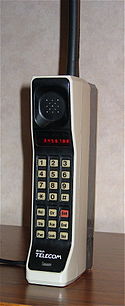
Martin Cooper, a Motorola researcher and executive is widely considered to be the inventor of the first practical mobile phone for hand-held use in a non-vehicle setting. Cooper is the first inventor named on "Radio telephone system" filed on October 17, 1973 with the US Patent Office and later issued as US Patent 3,906,166;[7] other named contributors on the patent included Cooper's boss, John F. Mitchell, Motorola's chief of portable communication products, who successfully pushed Motorola to develop wireless communication products that would be small enough to use outside the home, office or automobile and participated in the design of the cellular phone.[8][9] Using a modern, if somewhat heavy portable handset, Cooper made the first call on a hand-held mobile phone on April 3, 1973 to a rival, Dr. Joel S. Engel of Bell Labs.[10]
The first commercial citywide cellular network was launched in Japan by NTT in 1979. Fully automatic cellular networks were first introduced in the early to mid 1980s (the 1G generation). The Nordic Mobile Telephone (NMT) system went online in Denmark, Finland, Norway and Sweden in 1981.[11]

In 1983, Motorola DynaTAC was the first approved mobile phone by FCC in the United States. In 1984, Bell Labs developed modern commercial cellular technology (based, to a large extent, on the Gladden, Parelman Patent), which employed multiple, centrally controlled base stations (cell sites), each providing service to a small area (a cell). The cell sites would be set up such that cells partially overlapped. In a cellular system, a signal between a base station (cell site) and a terminal (phone) only need be strong enough to reach between the two, so the same channel can be used simultaneously for separate conversations in different cells.
Cellular systems required several leaps of technology, including handover, which allowed a conversation to continue as a mobile phone traveled from cell to cell. This system included variable transmission power in both the base stations and the telephones (controlled by the base stations), which allowed range and cell size to vary. As the system expanded and neared capacity, the ability to reduce transmission power allowed new cells to be added, resulting in more, smaller cells and thus more capacity. The evidence of this growth can still be seen in the many older, tall cell site towers with no antennae on the upper parts of their towers. These sites originally created large cells, and so had their antennae mounted atop high towers; the towers were designed so that as the system expanded—and cell sizes shrank—the antennae could be lowered on their original masts to reduce range.
Wednesday, August 19, 2009
Management
Management in all business and human organization activity is simply the act of getting people together to accomplish desired goals and objectives. Management comprises planning, organizing, staffing, leading or directing, and controlling an organization (a group of one or more people or entities) or effort for the purpose of accomplishing a goal. Resourcing encompasses the deployment and manipulation of human resources, financial resources, technological resources, and natural resources.
Overview
The verb manage comes from the Italian maneggiare (to handle — especially a horse), which in turn derives from the Latin manus (hand). The French word mesnagement (later ménagement) influenced the development in meaning of the English word management in the 17th and 18th centuries.[1]
Some definitions of management are:
- Organization and coordination of the activities of an enterprise in accordance with certain policies and in achievement of clearly defined objectives. Management is often included as a factor of production along with machines, materials, and money. According to the management guru Peter Drucker (1909–2005), the basic task of a management is twofold: marketing and innovation.
- Directors and managers who have the power and responsibility to make decisions to manage an enterprise. As a discipline, management comprises the interlocking functions of formulating corporate policy and organizing, planning, controlling, and directing the firm's resources to achieve the policy's objectives. The size of management can range from one person in a small firm to hundreds or thousands of managers in multinational companies. In large firms the board of directors formulates the policy which is implemented by the chief executive officer.
Theoretical scope
Mary Parker Follett (1868–1933), who wrote on the topic in the early twentieth century, defined management as "the art of getting things done through people". She also described management as philosophy.[2] One can also think of management functionally, as the action of measuring a quantity on a regular basis and of adjusting some initial plan; or as the actions taken to reach one's intended goal. This applies even in situations where planning does not take place. From this perspective, Frenchman Henri Fayol[3] considers management to consist of seven functions:
- planning
- organizing
- leading
- co-ordinating
- controlling
- staffing
- motivating
Some people, however, find this definition, while useful, far too narrow. The phrase "management is what managers do" occurs widely, suggesting the difficulty of defining management, the shifting nature of definitions, and the connection of managerial practices with the existence of a managerial cadre or class.
One habit of thought regards management as equivalent to "business administration" and thus excludes management in places outside commerce, as for example in charities and in the public sector. More realistically, however, every organization must manage its work, people, processes, technology, etc. in order to maximize its effectiveness. Nonetheless, many people refer to university departments which teach management as "business schools." Some institutions (such as the Harvard Business School) use that name while others (such as the Yale School of Management) employ the more inclusive term "management."
English speakers may also use the term "management" or "the management" as a collective word describing the managers of an organization, for example of a corporation. Historically this use of the term was often contrasted with the term "Labor" referring to those being managed.
Nature of managerial work
 | The neutrality of this section is disputed. Please see the discussion on the talk page. Please do not remove this message until the dispute is resolved. (December 2007) |
In for-profit work, management has as its primary function the satisfaction of a range of stakeholders. This typically involves making a profit (for the shareholders), creating valued products at a reasonable cost (for customers), and providing rewarding employment opportunities (for employees). In nonprofit management, add the importance of keeping the faith of donors. In most models of management/governance, shareholders vote for the board of directors, and the board then hires senior management. Some organizations have experimented with other methods (such as employee-voting models) of selecting or reviewing managers; but this occurs only very rarely.
In the public sector of countries constituted as representative democracies, voters elect politicians to public office. Such politicians hire many managers and administrators, and in some countries like the United States political appointees lose their jobs on the election of a new president/governor/mayor.
Public, private, and voluntary sectors place different demands on managers, but all must retain the faith of those who select them (if they wish to retain their jobs), retain the faith of those people that fund the organization, and retain the faith of those who work for the organization. If they fail to convince employees of the advantages of staying rather than leaving, they may tip the organization into a downward spiral of hiring, training, firing, and recruiting. Management also has the task of innovating and of improving the functioning of organizations.
Subscribe to:
Posts (Atom)


